Traumatic Brain Injury After an Accident: Legal and Practical Considerations


By Edvin Jones, Attorney at Law | Edvin Jones Injury Law | Contingency Fee Lawyer | traumatic brain injury lawyer Las Vegas

Quick Takes

  • TBI symptoms can be delayed — always seek medical evaluation after any accident involving a head impact or violent motion.
  • TBI ranges from mild concussion to severe injury causing permanent cognitive, physical, and behavioral impairment.
  • Future care costs for severe TBI can reach millions of dollars — your compensation claim must account for lifetime needs.
  • Insurance companies often dispute TBI claims by arguing that symptoms are pre-existing or exaggerated.
  • Neurologists, neuropsychologists, and life care planners play a critical role in documenting and valuing TBI claims.



Traumatic Brain Injury After an Accident: Legal and Practical Considerations

A traumatic brain injury (TBI) can occur in any accident that involves a blow to the head, a violent shake, or a penetrating head wound. Car accidents, motorcycle crashes, pedestrian collisions, falls, and workplace incidents are among the leading causes of TBI. The injury can range from a mild concussion that resolves within weeks to a severe, life-altering condition that permanently changes a person’s life.

For injury victims and their families, understanding how TBI affects a legal claim is essential. A traumatic brain injury lawyer Las Vegas residents can count on will ensure that every aspect of the injury — including long-term care needs that may not be apparent in the immediate aftermath — is fully documented and considered when pursuing compensation.

Why TBI Claims Are Uniquely Complex

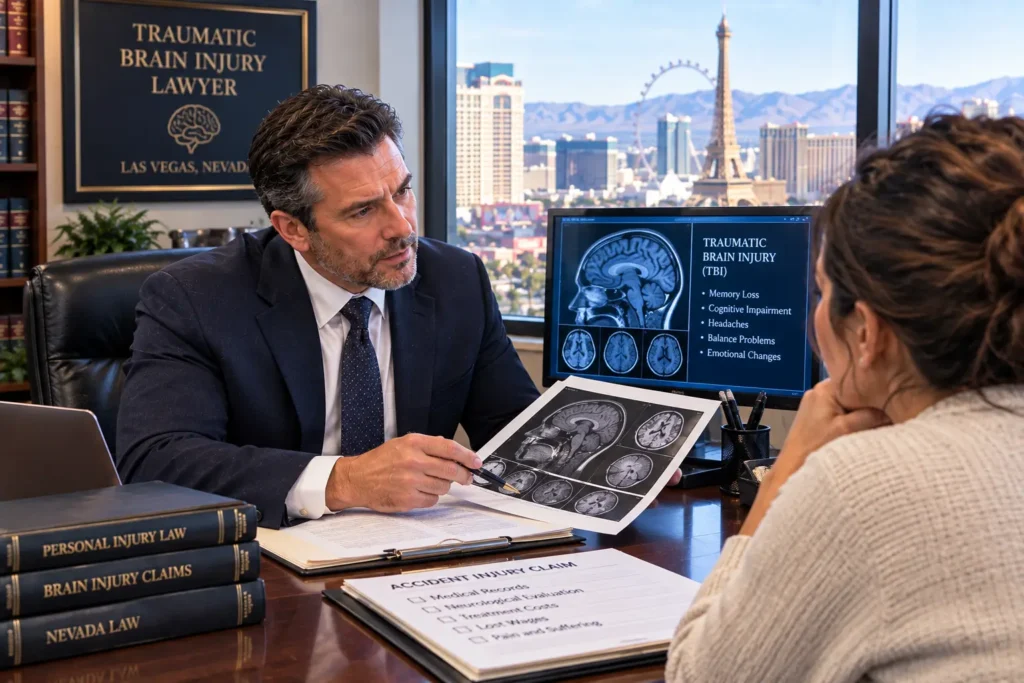
Brain injuries present unique legal challenges. Unlike a broken bone that shows clearly on an X-ray, many TBIs are not visible on standard imaging. Symptoms such as cognitive fog, memory loss, personality changes, chronic headaches, and emotional dysregulation may be dismissed by insurance adjusters as subjective or unverifiable.

This skepticism makes it essential to build a comprehensive medical record from specialized practitioners, including neurologists, neuropsychologists, and cognitive rehabilitation specialists.

Symptoms and Long-Term Effects of TBI

  • Cognitive impairment — memory loss, difficulty concentrating, and slowed processing speed
  • Physical symptoms — chronic headaches, dizziness, fatigue, and vision or hearing problems
  • Emotional and behavioral changes — depression, anxiety, impulsivity, and irritability
  • Sleep disorders — insomnia or excessive sleepiness may occur following TBI
  • Severe cases — profound disability requiring extensive assistance or full-time care

Calculating Compensation in a TBI Case

The value of a TBI claim depends heavily on the severity of the injury and its projected long-term impact. A mild concussion may resolve with a few months of treatment. A severe TBI may require years or even decades of cognitive therapy, in-home assistance, and adaptive equipment.

A life care planner can help project future medical and support costs, while an experienced attorney can present those needs effectively during settlement negotiations or at trial.

Compensation in TBI cases may include:

  • Medical expenses
  • Rehabilitation and therapy costs
  • Lost wages
  • Loss of future earning capacity
  • Pain and suffering
  • Emotional distress
  • Long-term care expenses
  • Disability-related accommodations

Contact Edvin Jones Injury Law — Free Consultation

No Win, No Fee. We Speak English, Farsi, Turkish, Russian & Arabic.

Contact Edvin Jones Injury Law — Free Consultation

No Win, No Fee. We Speak English, Farsi, Turkish, Russian & Arabic.

Address: 818 E Charleston Blvd, Las Vegas, NV 89104

Phone: 702-337-3430

Website: edvin.law

Instagram: edvinjonesinjurylaw  |  TikTok: edvin.law

Licensed in Nevada | Arizona | California

Disclaimer: This article is for informational purposes only and does not constitute legal advice. Reading this article does not create an attorney-client relationship.

Frequently Asked Questions

Can I have a TBI even if I did not lose consciousness?

Yes. Loss of consciousness is not required for a TBI diagnosis. Disorientation, confusion, memory gaps, and persistent headaches after a head impact can all indicate a brain injury.

How soon after an accident should I see a doctor for TBI?

Immediately. Some TBI symptoms, including dangerous intracranial bleeding, can be life-threatening and worsen without prompt treatment. Early medical evaluation also creates documentation connecting your symptoms to the accident.

How do I prove my TBI was caused by the accident?

Medical records, neuroimaging, neuropsychological testing, and expert testimony can help establish both the existence of a TBI and its connection to the accident.

Leave a Reply

Your email address will not be published. Required fields are marked *