By Edvin Jones, Attorney at Law | Edvin Jones Injury Law | Contingency Fee Lawyer
Distracted Driving Accidents: Proving Phone Use Caused Your Crash
Quick Takeaways
- Nevada restricts the use of handheld wireless communication devices while driving, subject to statutory exceptions.
- Phone records, video footage, witness testimony, police reports, and vehicle data may help establish that a driver was distracted.
- Evidence can disappear quickly, especially traffic-camera and surveillance footage, so prompt investigation matters.
- Distracted driving is not limited to texting or phone use; eating, adjusting navigation, reaching for objects, and other activities can also contribute to a crash.
- An experienced distracted driving accident lawyer in Nevada can help identify, preserve, and obtain evidence needed to establish liability.
Distracted Driving Accidents: Proving Phone Use Caused Your Crash
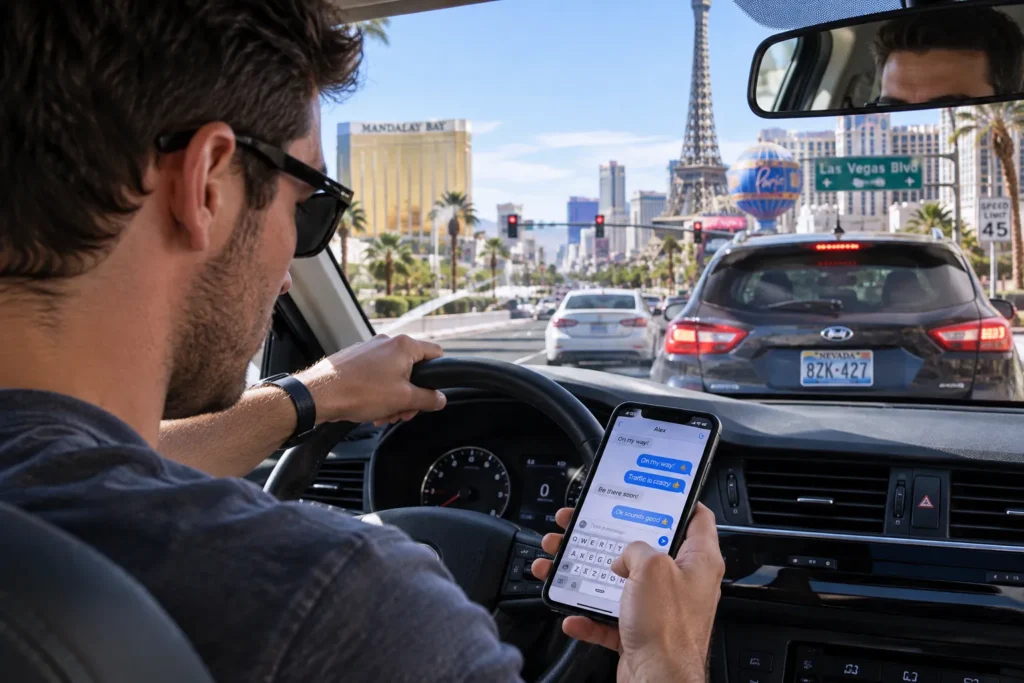
Distracted driving is a serious safety problem on Nevada roads. Drivers can become distracted by texting, phone calls, navigation systems, passengers, food, or other activities inside the vehicle.
Cell phone use can be particularly dangerous because it can involve several forms of distraction at the same time. A driver who looks down at a phone may not see a traffic signal, pedestrian, cyclist, stopped vehicle, or changing road conditions.
If you believe another driver was using a phone when they caused your accident, suspicion alone may not be enough to establish liability. The important question is what evidence can demonstrate that the driver’s distraction occurred and contributed to the crash.
A distracted driving accident lawyer in Nevada can investigate the collision and pursue evidence that may help establish what the driver was doing immediately before impact.
Nevada’s Distracted Driving Laws
Nevada law generally prohibits drivers from manually using a handheld wireless communications device to engage in activities such as voice communications, texting, or accessing information through the internet while driving, subject to statutory exceptions.
The law also provides enforcement mechanisms for violations.
A violation of a traffic-safety statute can be important evidence in a personal injury case. However, whether a particular statutory violation establishes negligence per se or otherwise affects liability depends on the specific facts and applicable Nevada law.
For that reason, proving that the other driver violated Nevada’s distracted-driving law can be highly relevant, but the circumstances connecting the violation to your accident still need to be established.
How Can Attorneys Prove a Driver Was Using a Phone?
Several types of evidence may help establish distracted driving.
Cell Phone Records
Phone records may provide information about calls, texts, or other communications around the time of a collision.
Depending on the circumstances, relevant records may be obtained through formal legal procedures rather than simply requested from the cellular provider by the injured person.
Traffic and Surveillance Video
Traffic cameras, business surveillance systems, residential security cameras, and dashcams may capture the moments immediately before a collision.
Video can be particularly valuable because it may show a driver’s movements, vehicle position, or behavior immediately before impact.
Eyewitness Testimony
Passengers, pedestrians, nearby drivers, and other witnesses may have seen the driver holding or looking at a phone.
A witness account can become especially important when there is no available video.
Police Reports
Police reports may contain:
- Statements from witnesses
- Officer observations
- Citations issued to the driver
- Statements made by the involved motorists
- Information about the driver’s behavior immediately after the collision
Vehicle Data
Some vehicles contain event data recorders that can provide information about circumstances surrounding a collision, such as speed, braking, and other vehicle inputs.
This information does not necessarily prove phone use by itself, but it can help reconstruct what happened.
What If the Driver Denies Using a Phone?
A driver’s denial does not necessarily end the investigation.
Evidence may contradict the driver’s account.
For example, an attorney may compare the driver’s statement with:
- Cell phone records
- Video footage
- Witness statements
- Police observations
- Vehicle data
- The driver’s timeline of events
- Statements made to insurance companies
A case does not necessarily depend on obtaining an admission from the driver.
The goal is to assemble reliable evidence showing what happened and whether the driver’s conduct caused or contributed to the collision.
Why Evidence Preservation Must Happen Quickly
Some of the most valuable evidence in distracted-driving cases may not remain available for long.
Surveillance systems can automatically overwrite recordings. Businesses may retain video for only a limited period, and witnesses’ memories can become less reliable over time.
For this reason, an attorney may send evidence-preservation requests to businesses, property owners, government entities, or other custodians of potentially relevant information.
Potentially important evidence can include:
- Traffic-camera footage
- Business surveillance video
- Dashcam recordings
- Witness information
- Police records
- Cell phone records
- Vehicle data
- Photographs of the accident scene
The sooner potentially relevant evidence is identified, the better the chance it can be preserved.
Distracted Driving Is More Than Texting
Although cell phone use receives significant attention, drivers can become distracted in many ways.
Examples include:
- Eating or drinking
- Adjusting the radio
- Programming a navigation system
- Looking at a GPS screen
- Reaching for an object
- Talking to passengers
- Looking at something outside the vehicle
- Applying makeup or grooming
- Using another electronic device
The key legal issue is whether the driver’s conduct constituted negligence and contributed to causing the accident.
What If There Is No Proof the Driver Was Using a Phone?
You can still potentially have a strong personal injury claim.
Phone use is only one possible form of negligence. Evidence may establish that the driver was speeding, following too closely, failed to yield, ran a red light, drove carelessly, or otherwise violated a duty of reasonable care.
A distracted-driving investigation should therefore look at the entire accident, rather than relying exclusively on phone records.
Contact Edvin Jones Injury Law — Free Consultation
No Win, No Fee. We Speak English, Farsi, Turkish, Russian & Arabic.
Address: 818 E Charleston Blvd, Las Vegas, NV 89104
Phone: 702-337-3430
Website: edvin.law
Instagram: edvinjonesinjurylaw | TikTok: edvin.law
Licensed in Nevada | Arizona | California
Disclaimer: This article is for informational purposes only and does not constitute legal advice. Reading this article does not create an attorney-client relationship.
Frequently Asked Questions
1. Can I get the other driver’s phone records on my own?
Generally, no. Cellular providers typically will not provide another person’s private phone records simply because you request them.
In litigation, relevant records may potentially be obtained through formal legal procedures, including subpoenas, subject to applicable privacy rules and court requirements.
An attorney can determine whether obtaining phone records is appropriate and legally available in your case.
2. What if the driver denies being on their phone?
A denial does not necessarily prevent you from proving distracted driving.
Phone records, video footage, witness testimony, police observations, and other evidence may contradict the driver’s version of events.
The strength of the evidence depends on the particular circumstances of the accident.
3. Is distracted driving while eating or using the radio actionable?
Potentially, yes.
A driver does not have to be using a cellphone for distraction to constitute negligence. If a driver’s conduct was unreasonable under the circumstances and caused the collision, it may support a negligence claim.
Phone use can provide particularly useful evidence when a statutory violation can be established, but it is not the only form of actionable distraction.
4. How quickly should I contact a distracted driving accident lawyer?
As soon as reasonably possible.
There may be time-sensitive evidence at the accident scene, including surveillance footage, traffic-camera recordings, vehicle data, and witness information.
Early legal involvement can also help preserve evidence and prevent important records from being lost or overwritten.
5. Can I still recover compensation if the distracted driver says I was partly responsible?
Potentially.
Nevada follows a modified comparative negligence system. If an injured person’s own negligence is alleged, the percentage of fault assigned to each party can affect the amount of compensation available.
An attorney can investigate the evidence and challenge an unfair attempt to shift responsibility onto the injured person.
Contact Edvin Jones Injury Law
If you were injured because another driver was distracted, identifying the cause of the crash can be critical to your claim.
Edvin Jones Injury Law can investigate the accident, identify potentially relevant evidence, communicate with insurance companies, and pursue compensation for qualifying losses.
Free Consultation
No Win, No Fee.
We speak English, Farsi, Turkish, Russian, and Arabic.
Address: 818 E Charleston Blvd, Las Vegas, NV 89104
Phone: 702-337-3430
Website: edvin.law
Licensed in: Nevada | Arizona | California