By Edvin Jones, Attorney at Law | Edvin Jones Injury Law | Las Vegas Casino Slip and Fall Lawyer
Quick Takeaways
- Report the slip and fall to the property before leaving and request an incident report number.
- Photograph the hazard, your injuries, your shoes, and the accident scene as soon as possible.
- Seek immediate medical treatment, even if your injuries seem minor.
- Nevada law generally requires proof that the property owner knew or should have known about the dangerous condition.
- Surveillance footage, maintenance logs, witness statements, and inspection records can be critical evidence.
- Avoid giving recorded statements or accepting a quick settlement before understanding the full extent of your injuries.
- Edvin Jones is your Las Vegas Casino Slip and Fall Lawyer in Las Vegas Injury Claims.
What To Do After a Slip and Fall in a Las Vegas Casino or Hotel
A fall inside a Las Vegas casino, hotel, restaurant, parking garage, pool deck, or resort walkway can turn a vacation or workday into a medical crisis. One moment you are walking through a marble lobby or a crowded buffet line; the next you are dealing with paramedics, security officers, pain, missed work, and an insurance company that wants a quick statement.
As Edvin Jones, I look at these cases differently than an adjuster does. A serious fall is not just a spill on the floor. It is a timeline. Who created the hazard? How long was it there? Who inspected the area? Was video preserved? Did employees know the condition kept happening? In Las Vegas, those answers often exist in surveillance footage, sweep logs, incident reports, employee radio traffic, and maintenance records.
Why Las Vegas Premises Cases Are Different
Las Vegas properties are built for volume. Thousands of people move through casino floors, hotel corridors, escalators, nightclubs, restaurants, valet areas, and pool decks every day. Drinks spill. Rainwater gets tracked inside. Tile becomes slick. Displays narrow walkways. Elevators and escalators break down. A property owner is not automatically responsible for every fall, but Nevada law expects businesses to act reasonably when dangerous conditions are known or should be discovered.
That is why early investigation matters. A casino may have excellent video coverage, but video can be overwritten. A hotel may have a written inspection policy, but the real question is whether employees followed it. A restaurant may claim the spill happened seconds before the fall, but a witness, receipt timestamp, or camera angle may show it sat there long enough to be addressed.
The first 48 hours can decide the case
After a fall, report the incident before leaving the property, ask for the incident number, photograph the exact hazard, photograph your shoes, get witness names, and seek medical care. Do not guess about how you fell. Do not say you are fine if you are not. Pain from a head injury, shoulder tear, back injury, hip fracture, or knee injury may become clearer after the adrenaline wears off.
What You Must Prove in a Nevada Slip-and-Fall Case
In Nevada, the injured person generally must prove that the property owner or operator failed to use reasonable care. In practical terms, that often means proving the business had actual notice of the dangerous condition or constructive notice, meaning the condition existed long enough, or happened often enough, that a reasonable business should have discovered and fixed it.
The Nevada Supreme Court’s decision in Sprague v. Lucky Stores, Inc., 109 Nev. 247, 849 P.2d 320 (1993), is important because it recognized that recurring debris in a produce area could support constructive notice. The lesson for casino and hotel cases is straightforward: a business cannot ignore predictable hazards created by the way it operates. If a chosen setup regularly creates a risk, the business may need mats, warnings, inspections, cleanup procedures, barriers, or a different layout.
Edvin Jones Injury Law looks for evidence that shows both the hazard and the property’s opportunity to prevent harm. That may include surveillance footage, cleaning logs, employee schedules, prior incident reports, weather data, maintenance requests, vendor records, and photos of lighting, flooring, transitions, mats, stairs, ramps, or handrails.

Common Defense Arguments After a Casino Fall
The defense will often argue that you were not watching where you were going, that the hazard was open and obvious, that your shoes caused the fall, that the spill appeared moments before impact, or that your medical condition was preexisting. These arguments are common, but they are not the end of the case.
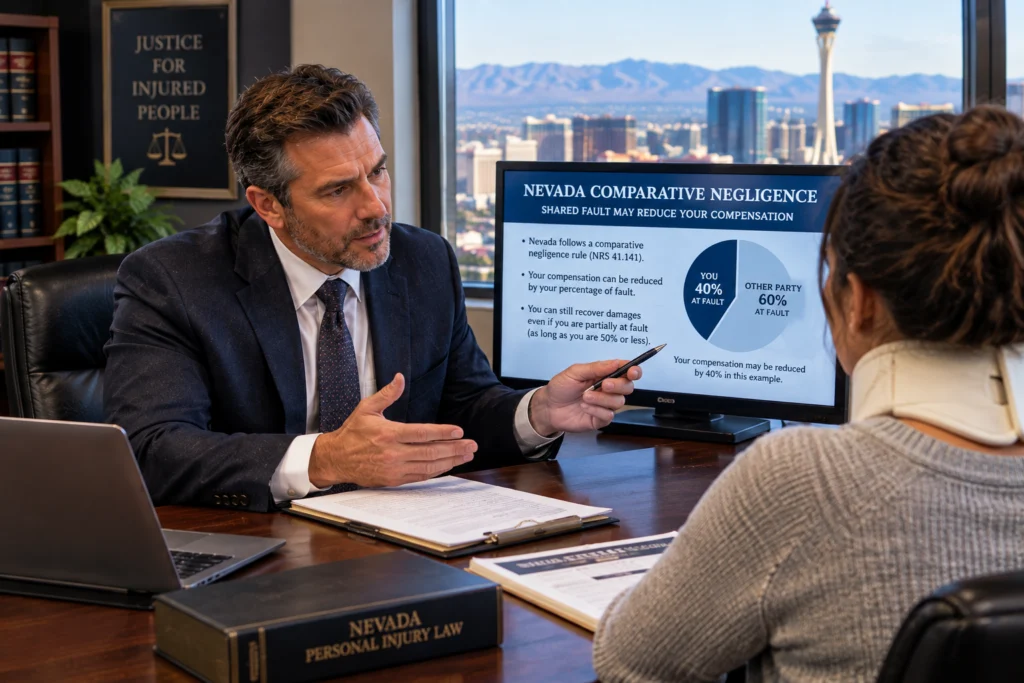
Nevada’s comparative fault rule can reduce an award if the injured person shares responsibility. That makes evidence essential. If a casino floor was crowded, poorly lit, visually distracting, wet from tracked-in rain, or arranged in a way that forced guests through a hazardous path, the context matters. A person walking normally through a resort should not be treated as if they accepted every hidden or poorly managed danger on the property.
Falls on the Strip, Downtown, and Beyond
Slip-and-fall claims in Las Vegas often involve tourists, convention visitors, hospitality workers, rideshare passengers, casino guests, and local residents. Injuries happen on the Strip, in Downtown Las Vegas, near Fremont Street, in Summerlin, Henderson, North Las Vegas, and along busy resort corridors. The location matters because the responsible party may be a casino operator, hotel management company, restaurant tenant, cleaning vendor, security contractor, parking operator, or government entity.
If you were hurt in or near a Las Vegas hotel or casino, contact Edvin Jones Injury Law at 818 E Charleston Blvd, Las Vegas, Nevada 89104, or call 702-337-3430. Edvin Jones can move quickly to preserve evidence before the property controls the story.
Nevada, California, and Arizona Law Compared
Nevada: Personal injury claims are generally subject to a two-year limitation period under NRS 11.190(4)(e). Comparative negligence is governed by NRS 41.141, which can reduce damages by the plaintiff’s percentage of fault and can bar recovery if the plaintiff’s negligence is greater than the negligence of the defendants. Nevada premises cases often turn on actual or constructive notice, with Sprague v. Lucky Stores, Inc. serving as a key constructive-notice case.
California: California’s general personal injury deadline is also two years under Cal. Code Civ. Proc. § 335.1. Premises liability is grounded in the broad ordinary-care duty of Cal. Civ. Code § 1714, and Rowland v. Christian, 69 Cal.2d 108 (1968), remains a foundational case on landowner duty. California follows pure comparative fault under Li v. Yellow Cab Co., 13 Cal.3d 804 (1975), so fault reduces damages by percentage rather than creating the same 50-percent-style cutoff used in Nevada.
Arizona: Arizona’s general personal injury deadline is two years under A.R.S. § 12-542. Comparative fault is addressed in A.R.S. § 12-2505. Arizona premises cases still focus heavily on whether the owner or occupier acted reasonably under the circumstances, including whether a dangerous condition was known, should have been known, or was unreasonably dangerous to an invitee.
Call Edvin Jones Before the Evidence Disappears
A hotel or casino may seem cooperative in the first few minutes after a fall, but the property’s insurer is not there to build your case. It is there to limit exposure. Before giving a recorded statement or accepting a fast settlement, get the injury, the property condition, and the insurance issues reviewed.
Call Edvin Jones Injury Law at 702-337-3430. From our office at 818 E Charleston Blvd, Las Vegas, Nevada 89104, Edvin Jones helps injured people and families across Nevada, California, and Arizona understand their rights and pursue full compensation after serious premises injuries.
*Edvin Jones is a personal injury attorney with decades of experience representing injured victims across Nevada, California, and Arizona. To speak with Edvin directly, contact Edvin Jones Injury Law at 818 E Charleston Blvd, Las Vegas, Nevada 89104 | 702-337-3430 | edvinjones.com*
Contact Edvin Jones Injury Law — Free Consultation
No Win, No Fee. We Speak English, Farsi, Turkish, Russian & Arabic.
Address: 818 E Charleston Blvd, Las Vegas, NV 89104
Phone: 702-337-3430
Website: edvin.law
Instagram: edvinjonesinjurylaw | TikTok: edvin.law
Licensed in Nevada | Arizona | California
Disclaimer: This article is for informational purposes only and does not constitute legal advice. Reading this article does not create an attorney-client relationship.
5 FAQs
1. What should I do immediately after a slip and fall in a Las Vegas casino?
Report the accident to management, seek medical care, photograph the scene and your injuries, collect witness information, and request an incident report before leaving the property.
2. Can I sue a casino or hotel for a slip and fall in Nevada?
Yes. If the property owner or operator failed to maintain reasonably safe premises or failed to correct or warn about a dangerous condition, you may have a premises liability claim.
3. What evidence is important in a slip and fall case?
Photos, surveillance video, maintenance records, cleaning logs, witness statements, medical records, and incident reports are among the most valuable forms of evidence.
4. What compensation can I recover?
You may be entitled to compensation for medical expenses, lost wages, pain and suffering, future medical treatment, rehabilitation costs, and other damages related to your injuries.
5. How long do I have to file a slip and fall lawsuit in Nevada?
In most cases, Nevada’s statute of limitations for personal injury claims is two years from the date of the accident.