By Edvin Jones, Attorney at Law | Edvin Jones Injury Law | Injury Claims Nevada
Quick Takeaways
- An insurance claim denial or delay does not necessarily mean your case lacks merit.
- Insurance companies may delay claims by requesting unnecessary documents or disputing liability, injuries, or coverage.
- Nevada law (NRS 686A.310) prohibits certain unfair insurance claim settlement practices.
- Keep copies of all medical records, bills, correspondence, and communications with the insurance company.
- First-party and third-party insurance claims involve different legal rights and strategies.
- Speaking with an experienced injury attorney early can help preserve evidence and strengthen your claim.
- Edvin Jones will help you with Injury Claims in Nevada.
What If the Insurance Company Delays or Denies Your Nevada Injury Claim?
By Edvin Jones, Esq. | Edvin Jones Injury Law
After a crash, fall, dog bite, or other injury, many people expect the insurance company to do the obvious thing: investigate the claim, review the medical records, and pay what is fair. Then the letters start. They say treatment was excessive, your injuries were preexisting, liability is still under investigation, coverage is questionable, or the offer is final. For an injured person trying to pay rent and medical bills, delay can feel like pressure.
I am Edvin Jones, and I want injury victims to understand this clearly: a delay or denial is not the final word. It is often a tactic, a coverage position, or an opening move in negotiation. The right response depends on the facts, the insurance policy, the state law involved, and the evidence already preserved.
Why Insurers Delay or Deny Valid Injury Claims
Insurance companies handle claims in volume. The adjuster may be polite, but the company’s financial incentive is to pay less, pay later, or pay nothing when it can justify doing so. Common delay tactics include repeated requests for the same records, long gaps between communications, blaming another insurer, questioning medical necessity, asking for a recorded statement before you know the full extent of injury, or making a low offer before treatment is complete.
A denial can be based on liability, causation, damages, coverage, exclusions, missed deadlines, or alleged lack of cooperation. Some denials are defensible. Others collapse when an attorney demands the claim file, identifies the applicable coverage, documents the injuries properly, and forces the insurer to explain its position in writing.
Do not argue from emotion alone
Being angry is understandable. But the stronger move is evidence. Keep every letter, email, portal message, text, estimate, medical bill, explanation of benefits, and voicemail. Write down the date, time, adjuster name, claim number, and what was said. If the insurer gives a reason for delay or denial, ask for it in writing.
Nevada Law on Unfair Claim Practices
Nevada has a specific unfair-claims statute: NRS 686A.310. The statute identifies unfair practices in settling claims, including failing to act reasonably promptly on communications, failing to adopt reasonable standards for prompt investigation and processing, refusing to pay claims without conducting a reasonable investigation, failing to affirm or deny coverage within a reasonable time after proof-of-loss requirements are completed, and failing to provide a reasonable explanation for denial or compromise offers.
For injury victims, the practical point is not to quote statutes at the adjuster and hope the file changes. The practical point is to create a record. If an insurer is delaying, Edvin Jones Injury Law presses for the basis of the delay, the coverage position, the missing documents, the medical review, and the authority for any low offer. A vague response helps no one. A documented response can move the claim or expose the problem.
First-Party and Third-Party Claims Are Different
A first-party claim is usually against your own insurer, such as uninsured motorist coverage, underinsured motorist coverage, medical payments coverage, homeowners coverage, or another policy you bought. A third-party claim is against the at-fault person’s insurance company. The duties, remedies, and leverage can differ.
In a Nevada car accident, for example, you may have a third-party bodily injury claim against the careless driver and a first-party UM/UIM claim against your own insurer if the other driver has no insurance or not enough insurance. In a severe crash, both tracks may matter. Edvin Jones looks at all available coverage instead of accepting the first adjuster’s framing of the claim.

How To Respond to a Delay, Underpayment, or Denial
Start by getting organized. Gather the police report, photos, medical records, bills, proof of missed work, insurance declarations pages, claim letters, and names of every adjuster. Do not sign a broad medical authorization without understanding what it allows the insurer to collect. Do not accept a settlement that releases all claims if you are still treating or do not know whether surgery, injections, specialist care, or long-term limitations are likely.
Next, identify the reason for the insurer’s position. Is it saying its insured was not at fault? Is it disputing the seriousness of the injury? Is it claiming there is no coverage? Is it pointing to a policy exclusion? Is it waiting on records it never properly requested? Each reason requires a different response.
Edvin Jones Injury Law, located at 818 E Charleston Blvd, Las Vegas, Nevada 89104, can review the claim and communicate directly with insurers. Call 702-337-3430 before a delay turns into a missed deadline or a low settlement becomes a closed file.
Las Vegas Injury Claims and Southwest Insurance Issues
Insurance disputes in Las Vegas often involve crashes on I-15, US 95, Summerlin Parkway, Charleston Boulevard, Sahara Avenue, Tropicana Avenue, and the resort corridor. They also arise from casino falls, apartment injuries, dog bites, motorcycle crashes, truck accidents, rideshare collisions, and pedestrian injuries. Because many people in Las Vegas travel between Nevada, California, and Arizona, the claim may involve out-of-state drivers, out-of-state policies, or treatment in more than one state.
That regional reality matters. A Nevada accident with a California driver, an Arizona insurer, and Las Vegas medical treatment needs careful jurisdictional analysis. The insurer may use confusion to slow the claim. A focused legal strategy cuts through that confusion.
Nevada, California, and Arizona Law Compared
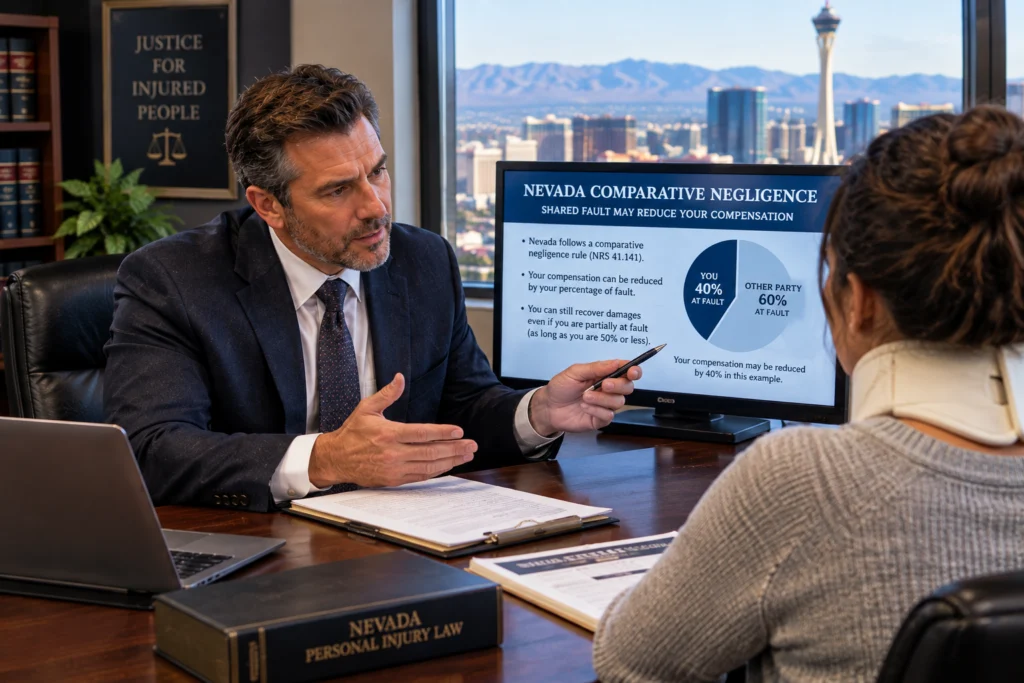
Nevada: The general personal injury lawsuit deadline is two years under NRS 11.190(4)(e). Nevada’s modified comparative negligence rule appears in NRS 41.141. For claim handling, NRS 686A.310 is the key unfair-claims statute and provides a legal framework when insurers fail to investigate, respond, explain, or settle claims reasonably.
California: California’s general personal injury deadline is two years under Cal. Code Civ. Proc. § 335.1. California Insurance Code § 790.03(h) identifies unfair claims settlement practices. California also follows pure comparative fault under Li v. Yellow Cab Co., meaning damages are reduced by the injured person’s percentage of fault rather than barred at Nevada’s comparative-negligence threshold.
Arizona: Arizona’s general injury deadline is two years under A.R.S. § 12-542. A.R.S. § 20-461 lists unfair claim settlement practices, including failing to promptly settle claims where liability has become reasonably clear and failing to provide a reasonable explanation for denial or compromise offers. A.R.S. § 12-2505 governs comparative negligence in Arizona.
Call Before You Give the Insurance Company More Leverage
If your claim has been delayed, denied, or undervalued, you do not have to keep negotiating alone. The insurer has professionals protecting its money. You should have someone protecting your health, your evidence, and your future.
Contact Edvin Jones Injury Law at 702-337-3430. Edvin Jones represents injured people across Nevada, California, and Arizona and can evaluate whether the insurer’s position is legitimate, incomplete, or unfair.
*Edvin Jones is a personal injury attorney with decades of experience representing injured victims across Nevada, California, and Arizona. To speak with Edvin directly, contact Edvin Jones Injury Law.
Contact Edvin Jones Injury Law — Free Consultation
No Win, No Fee. We Speak English, Farsi, Turkish, Russian & Arabic.
Address: 818 E Charleston Blvd, Las Vegas, NV 89104
Phone: 702-337-3430
Website: edvin.law
Instagram: edvinjonesinjurylaw | TikTok: edvin.law
Licensed in Nevada | Arizona | California
Disclaimer: This article is for informational purposes only and does not constitute legal advice. Reading this article does not create an attorney-client relationship.
5 FAQs
1. Why is the insurance company delaying my injury claim?
Insurance companies may delay claims while investigating liability, requesting additional records, reviewing medical treatment, or evaluating coverage. In some cases, delays are strategic rather than necessary.
2. Can an insurance company deny my personal injury claim?
Yes. Claims may be denied because of disputes over liability, causation, policy exclusions, insufficient evidence, or coverage issues. A denial should be carefully reviewed before accepting it as final.
3. What should I do if my claim is denied?
Request the reason for the denial in writing, preserve all documents related to your claim, and consult a personal injury attorney before making recorded statements or accepting the insurer’s decision.
4. What is considered an unfair insurance practice in Nevada?
Nevada law prohibits insurers from unreasonably delaying investigations, failing to respond promptly, denying claims without a reasonable investigation, or failing to explain claim decisions adequately.
5. Can a lawyer help if the insurance company made a low settlement offer?
Yes. An attorney can evaluate the offer, gather additional evidence, negotiate with the insurer, and, when appropriate, pursue litigation to seek full compensation.