By Edvin Jones, Attorney at Law | Edvin Jones Injury Law | personal injury law Nevada California Arizona
Quick Takeaways
- The state where an accident occurs often plays an important role in determining which state’s law applies, but multi-state cases can involve more complicated choice-of-law questions.
- Nevada, California, and Arizona have different rules concerning comparative fault and how an injured person’s own negligence affects recovery.
- Statutes of limitations differ depending on the state, the type of claim, and whether a government entity is involved.
- Damage caps and procedural requirements vary significantly among the three states and can depend on the type of claim.
- Edvin Jones is licensed in Nevada, California, and Arizona, allowing the firm to evaluate personal injury matters involving multiple jurisdictions.
- Edvin Jones Law Firm is your trusted personal injury law Nevada California Arizona in USA.
Nevada vs. California vs. Arizona Personal Injury Law: Why the Difference Matters
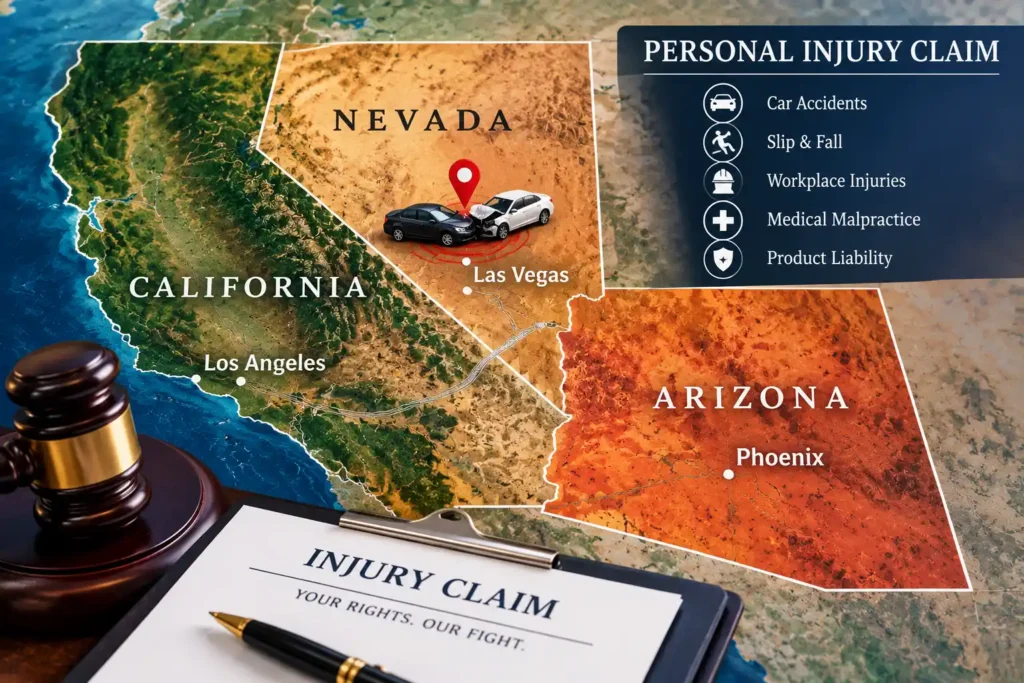
The Las Vegas region is close to both California and Arizona, and residents, tourists, commuters, and commercial drivers regularly cross state lines.
Accidents can happen on major interstate routes, near state borders, along the Colorado River, or while traveling between cities in the Southwest.
When an injury occurs in one state but the people, insurance policies, businesses, or other circumstances involve another state, determining which law applies can become important.
The rules governing negligence, filing deadlines, comparative fault, damages, and insurance claims are not identical in Nevada, California, and Arizona.
Because Edvin Jones Injury Law is licensed in all three states, the firm can evaluate cases involving these jurisdictions and determine what legal issues may affect the claim.
Statutes of Limitations: How Long Do You Have to File?
One of the most important differences between states is the statute of limitations.
For many ordinary personal injury claims, the general deadlines are:
| State | General Personal Injury Deadline | Government Claims |
|---|---|---|
| Nevada | Generally 2 years | Special rules may apply |
| California | Generally 2 years | Special government-claim deadlines may apply |
| Arizona | Generally 2 years | Generally requires a notice of claim within 180 days |
These are general rules, not a substitute for determining the deadline in a particular case.
Certain claims can have different statutes of limitations, and claims involving government entities can have special notice requirements.
Missing an applicable deadline can prevent an injured person from pursuing a claim, even when substantial evidence supports the underlying case.
If you are unsure which deadline applies, seek legal advice as soon as possible.
Comparative Fault: Nevada vs. California vs. Arizona
Another major difference concerns comparative negligence or comparative fault.
Nevada: Modified Comparative Negligence
Nevada generally follows a modified comparative negligence system.
If an injured person is 51% or more at fault, recovery is generally barred. If the person’s fault is 50% or less, damages are generally reduced according to their percentage of fault.
For example, if a person is found 30% responsible for an accident and has $100,000 in qualifying damages, the recovery may be reduced to $70,000, subject to the applicable law and facts.
California: Pure Comparative Negligence
California generally follows pure comparative negligence.
An injured person can potentially recover damages even if they were primarily responsible for the accident. The recovery is reduced according to their percentage of fault.
For example, a person found 80% at fault could potentially recover 20% of their qualifying damages.
Arizona: Pure Comparative Fault
Arizona generally follows a pure comparative fault approach as well.
A plaintiff’s recovery can be reduced according to their percentage of fault rather than being automatically eliminated simply because they were more than 50% responsible.
Why Comparative Fault Matters
This difference can be significant in cases where both sides dispute who caused the accident.
A person facing a substantial fault allegation should not automatically assume that they have no claim. The effect of comparative fault depends on the applicable state’s law and the evidence establishing each party’s responsibility.
Damage Caps and Special Rules
The amount and types of damages available can also differ depending on the state and the nature of the claim.
Nevada
Nevada has specific limitations concerning non-economic damages in certain medical malpractice cases. The rules and applicable limits can depend on when the claim arose and other circumstances.
California
California has historically limited non-economic damages in medical malpractice cases under MICRA. The applicable limits have changed in recent years, so the law in effect when the claim arose must be considered.
Arizona
Arizona generally does not impose a broad cap on damages in ordinary personal injury cases. However, medical malpractice claims and other specialized cases can involve particular legal rules.
Because damage rules can change and vary by claim type, the applicable law should be reviewed rather than relying on a general state-by-state comparison.

Uninsured and Underinsured Motorist Coverage
Insurance coverage can create another layer of complexity in multi-state accidents.
The minimum liability requirements and rules governing uninsured or underinsured motorist coverage differ among Nevada, California, and Arizona.
Nevada
Nevada requires insurers to offer uninsured and underinsured motorist coverage, subject to applicable statutory requirements. Nevada’s minimum liability limits are generally $25,000 per person / $50,000 per accident for bodily injury.
California
California requires insurers to offer uninsured motorist coverage, although California law permits insureds to reject certain UM coverage in writing. California’s minimum liability limits are generally $30,000 per person / $60,000 per accident under current law.
Arizona
Arizona generally requires insurers to offer uninsured and underinsured motorist coverage, subject to applicable requirements. Arizona’s minimum liability limits are generally $25,000 per person / $50,000 per accident for bodily injury.
Insurance coverage can be governed by rules different from those governing the underlying accident claim. The location of the accident, the terms of the policy, the insured’s residence, and other factors can all matter.
Which State’s Law Applies to a Multi-State Accident?
The state where the accident occurred is often an important starting point, but it is not necessarily the end of the analysis.
Courts can apply choice-of-law rules when a case has meaningful connections to more than one state.
For example, consider a collision involving:
- A Nevada resident;
- A California driver;
- An Arizona-registered vehicle;
- An accident occurring near a state border; and
- Insurance issued in another state.
Determining which substantive law applies may require examining the specific connections between the accident and each state.
The appropriate court, venue, jurisdiction, insurance policy, and substantive law should therefore be evaluated separately.
What If the Accident Happened on a State Border?
Border accidents can create unusual factual and legal questions.
If the exact location of a collision is disputed, evidence such as police reports, photographs, GPS information, road markers, witness statements, and accident reconstruction may help establish where the accident occurred.
The precise location can matter because it may affect which state’s laws and government agencies are involved.
If the accident occurred close to the Nevada-Arizona or Nevada-California border, it is especially important not to assume that the law of your home state automatically controls the claim.
Can You File a Personal Injury Case in Any of the Three States?
Not necessarily.
The state where a lawsuit can appropriately be filed is a separate question from which state’s substantive law governs the dispute.
A court must generally have appropriate personal jurisdiction over the parties and the case must satisfy applicable venue requirements.
In a multi-state case, an attorney may need to evaluate:
- Where the accident occurred;
- Where the parties live or conduct business;
- Where relevant evidence is located;
- Which court has jurisdiction;
- Which venue is appropriate; and
- Which state’s substantive law should apply.
The most appropriate forum is not necessarily the state with the most favorable law.
Why Multi-State Personal Injury Cases Require Careful Analysis
A case involving Nevada, California, and Arizona can involve several overlapping legal questions.
For example, the state governing negligence may differ from the state connected to an insurance policy. A government defendant may trigger additional notice requirements, while a medical malpractice claim may have specialized rules that do not apply to ordinary automobile accidents.
These issues can affect:
- Filing deadlines
- Comparative fault
- Available damages
- Insurance coverage
- Procedural requirements
- Court jurisdiction
- Venue
- Government immunity and notice requirements
Getting the jurisdictional analysis right early can help prevent costly mistakes later.
Contact Edvin Jones Injury Law
If you were injured in Nevada, California, or Arizona—or your accident involves parties, insurance policies, or evidence connected to multiple states—understanding the applicable law can be critical.
Free Consultation
No Win, No Fee.
We speak English, Farsi, Turkish, Russian, and Arabic.
Contact Edvin Jones Injury Law — Free Consultation
No Win, No Fee. We Speak English, Farsi, Turkish, Russian & Arabic.
Address: 818 E Charleston Blvd, Las Vegas, NV 89104
Phone: 702-337-3430
Website: edvin.law
Instagram: edvinjonesinjurylaw | TikTok: edvin.law
Licensed in Nevada | Arizona | California
Disclaimer: This article is for informational purposes only and does not constitute legal advice. Reading this article does not create an attorney-client relationship.
Frequently Asked Questions
1. If I was injured on the Nevada-Arizona border, which state’s law applies?
The answer depends on the precise location of the accident and the facts connecting the claim to each state.
The law of the state where the accident occurred is often highly relevant, but multi-state cases can involve additional choice-of-law considerations. If the location is disputed, evidence such as accident reports, photographs, GPS data, and witness statements may be important.
2. Can I file my case in any of the three states if I have connections to Nevada, California, and Arizona?
Not necessarily.
Where a lawsuit can be filed depends on jurisdiction and venue rules. Even when a court has jurisdiction, that does not automatically mean that the state’s substantive personal injury law will govern every issue.
A multi-state case should therefore be evaluated based on its specific facts before choosing where to file.
3. Does California’s pure comparative negligence rule benefit accident victims more than Nevada’s rule?
It can, particularly when an injured person is assigned a significant percentage of fault.
Under California’s pure comparative negligence approach, a plaintiff can generally recover a portion of damages even when they are more than 50% at fault. Nevada’s modified comparative negligence rule generally bars recovery once the plaintiff reaches 51% fault.
Other differences in damages, insurance coverage, procedural rules, and the facts of the accident can also affect the overall outcome.
4. Does my home state determine which personal injury law applies?
Not necessarily.
Your residence can be one factor in a multi-state legal analysis, but the location of the accident, the parties involved, insurance relationships, and other connections may also matter.
The applicable law should be determined based on the specific circumstances rather than simply the injured person’s state of residence.
5. What should I do if I was injured while traveling between Nevada, California, and Arizona?
Seek appropriate medical care, document the accident, preserve evidence, obtain insurance information, and avoid assuming that the law of your home state automatically controls the claim.
Because filing deadlines and legal rules can differ, consult an attorney as soon as possible if the accident involves multiple states.